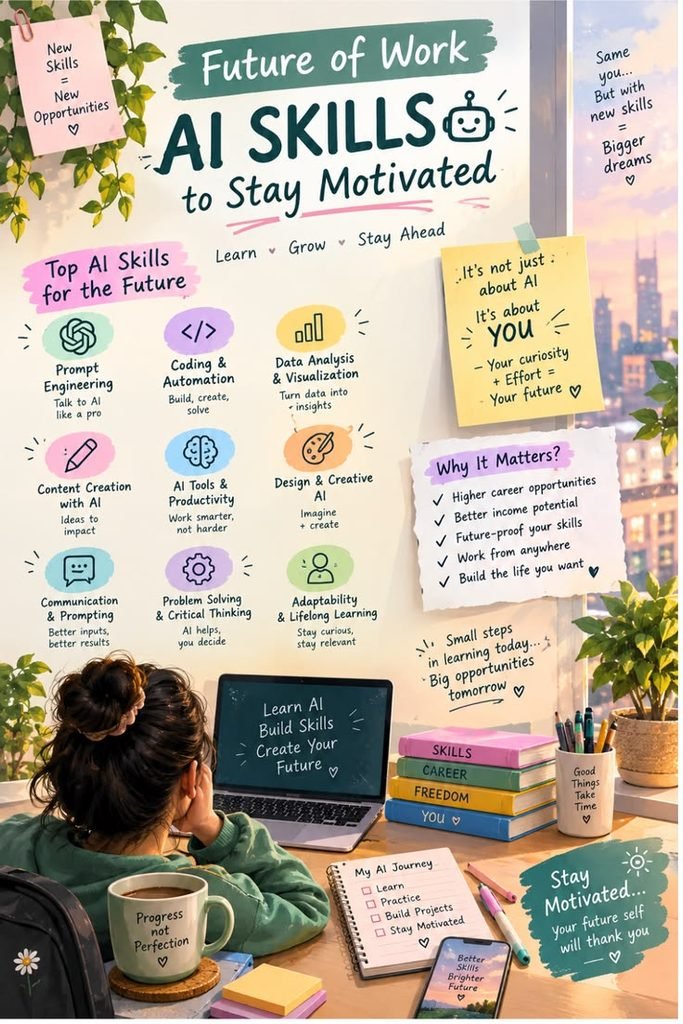
Artificial intelligence is changing how businesses operate, how professionals complete tasks, and how employers identify the skills they need. From healthcare and finance to education, marketing, engineering, and customer service, AI-powered technologies are becoming part of everyday professional activities.
As organizations continue adopting AI tools, employees who understand how to use these technologies may gain an advantage when applying for jobs, developing their careers, or starting independent businesses.
The good news is that you do not need to become a software engineer or have a university degree in computer science to begin learning AI skills. Many practical AI abilities can be developed through online courses, tutorials, personal projects, and regular practice.
But where should you start, which skills should you learn, and how can you use AI knowledge to improve your career opportunities?
1. Understand the Basics of Artificial Intelligence
Before learning advanced AI tools, it is important to understand what artificial intelligence is and how it works.
Artificial intelligence refers to technologies that enable computer systems to perform tasks that normally require human intelligence. These tasks may include understanding language, recognizing images, analyzing information, making predictions, and generating content.
You should become familiar with basic AI concepts such as:
- Machine learning
- Generative AI
- Natural language processing
- Computer vision
- Deep learning
- AI automation
- Large language models
You do not need to understand every technical detail immediately. Start with the basic concepts and learn how AI is used in different industries.
Understanding these foundations will make it easier to identify which AI skills are relevant to your career.
2. Learn How to Use AI Tools
One of the easiest ways to begin developing AI skills is by experimenting with practical AI applications.
Many tools are designed for people without technical backgrounds. They can help with writing, research, productivity, design, data analysis, and business operations.
Some popular AI tools include:
- ChatGPT: Useful for brainstorming, research assistance, writing support, explanations, and productivity.
- Google Gemini: Supports information exploration, writing, reasoning, and other AI-assisted tasks.
- Microsoft Copilot: Helps users with productivity and AI-assisted tasks across supported Microsoft products.
- Canva AI: Offers AI-powered features for visual design and content creation.
- Grammarly: Provides writing assistance, grammar suggestions, and AI-supported editing features.
Do not focus only on learning how to open these applications. Learn how to use them to solve real problems.
For example, a marketing professional can explore how AI supports campaign planning, while a business administrator can practise using AI to organize information and prepare reports.
3. Develop Prompt Engineering Skills
Prompt engineering involves creating clear instructions that guide AI systems toward useful responses.
The quality of your instructions can influence the usefulness of the results you receive. A vague prompt may produce a general answer, while a detailed prompt can provide more relevant information.
For example, instead of asking an AI tool to “write about marketing,” you could ask it to develop a beginner-friendly marketing plan for a small online business, including its target audience, promotional channels, and content ideas.
To improve your prompting skills:
- Explain what you want the AI tool to accomplish.
- Provide relevant background information.
- Identify the audience or intended purpose.
- Request a suitable format.
- Include important limitations.
- Review and improve the results.
Prompting is useful across many professions, including writing, education, customer service, research, business administration, and digital marketing.
However, always check AI-generated information for accuracy, originality, and relevance.
4. Learn Data Analysis With AI
Data analysis is another valuable area to explore because businesses use information to understand customers, monitor performance, and make decisions.
AI-powered tools can help professionals organize information, identify patterns, summarize datasets, and generate useful insights.
You can begin by learning basic spreadsheet skills and gradually explore more advanced tools.
Useful areas to study include:
- Microsoft Excel
- Google Sheets
- Data visualization
- Basic statistics
- Data interpretation
- SQL fundamentals
- AI-assisted data analysis
For example, a business professional could use spreadsheet tools to examine monthly sales figures and identify changes in customer demand.
If you enjoy working with numbers and solving problems, combining data analysis with AI knowledge could open opportunities in business intelligence, finance, marketing analytics, and operations.
5. Explore AI Automation
Businesses often perform repetitive tasks that require time and attention. AI automation can help organize or simplify some of these activities.
Learning how automation works can help you understand how organizations improve productivity and manage workflows.
You could begin by exploring:
- Automated email organization
- Customer support workflows
- Document processing
- Appointment scheduling
- Data entry automation
- Workflow management
- AI-assisted reporting
Tools such as Zapier and Make allow users to connect different applications and automate certain tasks.
For example, a business could create a workflow that collects information from an online form and organizes it in a spreadsheet.
Start with simple automation projects before attempting more complicated systems. Always understand what information is being shared and check automated results for errors.
6. Choose AI Skills Related to Your Career
You do not need to learn every AI technology available. A better approach is to identify the tools and skills that complement your existing profession or desired career.
Different industries use AI in different ways.
Marketing: Learn AI-assisted content planning, customer research, campaign analysis, and marketing automation.
Finance: Explore AI-assisted data analysis, financial forecasting concepts, fraud detection, and reporting.
Healthcare: Understand how AI supports medical research, administrative processes, and healthcare information systems, while respecting professional and regulatory requirements.
Education: Learn how AI can support lesson planning, learning materials, research, and personalized educational activities.
Human resources: Explore AI-assisted recruitment administration, workforce analytics, and employee communication.
Technology: Consider machine learning, programming, cloud computing, AI application development, and cybersecurity.
Choosing career-related AI skills helps you develop knowledge that can be applied to real workplace responsibilities.
7. Learn Basic Programming if You Want a Technical AI Career
Although many AI tools can be used without programming, technical careers often require deeper knowledge.
If you want to become an AI developer, machine learning engineer, or data scientist, learning programming can be an important step.
Python is a popular programming language used in AI development because it has a large ecosystem of libraries and learning resources.
You can gradually explore:
- Python programming
- Data structures
- Basic mathematics and statistics
- Machine learning fundamentals
- Data preparation
- Model evaluation
- AI application development
Libraries such as TensorFlow, PyTorch, and scikit-learn are commonly used in machine learning projects.
You do not need to master everything at once. Begin with programming fundamentals and build small projects as your knowledge improves.
8. Take Online AI Courses and Training
Online learning makes it possible to develop AI knowledge without attending a traditional university.
You can explore introductory courses, professional certificates, tutorials, and structured training programmes.
Some useful learning platforms include:
- Coursera: Offers AI and machine learning courses from universities and other educational organizations.
- edX: Provides online learning programmes covering artificial intelligence, computer science, and related subjects.
- Google Cloud Skills Boost: Offers training resources covering AI, machine learning, and cloud technologies.
- Microsoft Learn: Provides learning paths for AI concepts and Microsoft technologies.
- DeepLearning.AI: Offers educational programmes covering generative AI, machine learning, and related technical subjects.
Before choosing a course, check its syllabus, learning requirements, cost, practical exercises, and certificate conditions.
A certificate can demonstrate that you completed training, but employers may also want evidence that you can apply what you learned.
9. Build Practical AI Projects
One of the best ways to demonstrate your AI skills is by creating projects.
Instead of only watching tutorials, use what you learn to solve practical problems.
For example:
- A marketing learner can create an AI-assisted content research workflow.
- A data analysis beginner can examine a public dataset and present the findings.
- A virtual assistant can develop a workflow for organizing administrative information.
- A programmer can build a simple application using an AI API.
- A student can create a research assistant prototype using publicly available information.
Document your projects and explain the problem, the tools you used, your approach, and the results.
You can showcase suitable projects through LinkedIn, GitHub, a personal website, or an online portfolio.
Avoid including confidential information or presenting AI-generated work as something you developed independently when you did not.
10. Add AI Skills to Your CV and LinkedIn Profile
After developing practical experience, update your professional profiles to reflect your new abilities.
Recruiters may search for candidates using specific AI-related keywords, so it is useful to include relevant skills where they accurately describe your knowledge.
Examples include:
- Generative AI
- Prompt engineering
- AI productivity tools
- Machine learning
- Data analysis
- AI automation
- Python programming
- Natural language processing
- AI-assisted content creation
Do not simply add popular AI terms to your CV. Be prepared to explain how you have used the tools and what you achieved.
For example, instead of writing only “AI skills,” describe a project where you used an AI tool to organize research, analyze information, or improve a workflow.
This gives employers a clearer understanding of your practical abilities.
11. Join AI Communities and Professional Networks
Learning AI does not have to be a completely independent activity.
Joining professional communities can help you discover useful resources, discuss challenges, learn about new technologies, and connect with people working in the field.
You can participate in:
- LinkedIn AI communities
- Online technology forums
- Programming communities
- AI webinars
- Virtual workshops
- Professional networking events
- Open-source project communities
Following AI researchers, educators, developers, and industry professionals can also help you understand how the technology is evolving.
Networking may introduce you to mentors, collaborators, internships, freelance projects, and employment opportunities.
12. Keep Updating Your AI Knowledge
Artificial intelligence develops quickly. New tools, features, applications, and workplace practices continue to emerge.
A skill that is useful today may need to be updated as technology changes.
Create a realistic learning routine. For example, you could spend a few hours each week studying AI concepts, testing tools, completing practical exercises, and reviewing industry developments.
Focus on understanding the principles behind the technology rather than depending entirely on one application.
Also develop human skills such as critical thinking, creativity, communication, adaptability, and problem-solving. These abilities help you evaluate AI-generated results and use technology responsibly.
Final Thoughts
Learning AI skills can help you prepare for changing workplace expectations and explore new career opportunities. Whether you work in marketing, finance, education, administration, technology, or another professional field, understanding how to use AI effectively can complement your existing abilities.
Start by learning the basics, experiment with accessible tools, choose skills related to your career, and practise through real projects.
You do not have to become an AI expert overnight. Consistent learning, practical experience, and the ability to use technology responsibly can help you build a stronger professional profile and prepare for future opportunities.