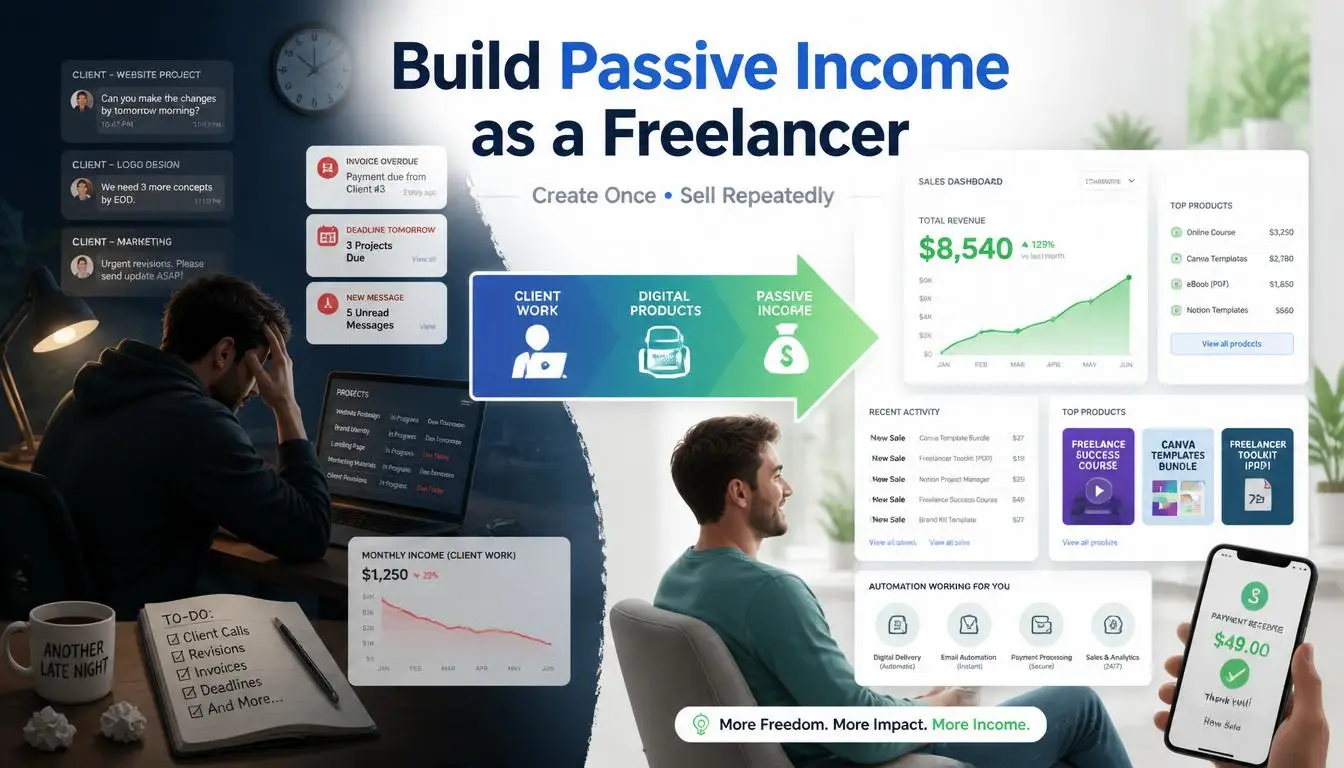
Freelancing gives you freedom, flexibility, and the ability to work on your own terms. But there is one problem almost every freelancer faces: the moment you stop working, your income stops too.
This is one of the most common challenges freelancers face, whether they are just starting out or have been doing it for years. Client dependency is the core problem. When you lock a client for two or three months, those months feel secure. But once that contract ends, the anxiety kicks in. What if four or five clients leave at once? It happens.
This guide covers how to reduce that dependency significantly by building a system where one-time effort generates income again and again.
Why Freelancing Income Feels Unstable
When you work as a freelancer, the math is simple: more work equals more money, less work equals less money, no work equals zero.
Compare this to a job. In a salaried position, you get paid for 30 days even if you only had active work for 20 of them. Weekends off, slow days, no problem, the salary still comes.
Freelancing does not work that way. You earn for exactly the days you work.
Freelancing appears straightforward from the outside – get a client, do the work, get paid. People think getting a client is the hard part, and once you have one, the money flows. But the reality is that your income becomes deeply tied to how many hours you put in. Work-life balance suffers. Many freelancers end up working extremely long hours just to keep their monthly earnings up.
And if anything takes your focus away from client work even for a few days, your revenue takes a direct hit.
What Smart Freelancers Do Differently
Successful freelancers share one key habit: instead of selling their time, they sell products, systems, and assets that can be created once and sold repeatedly.
How to Structure Your Freelance Income
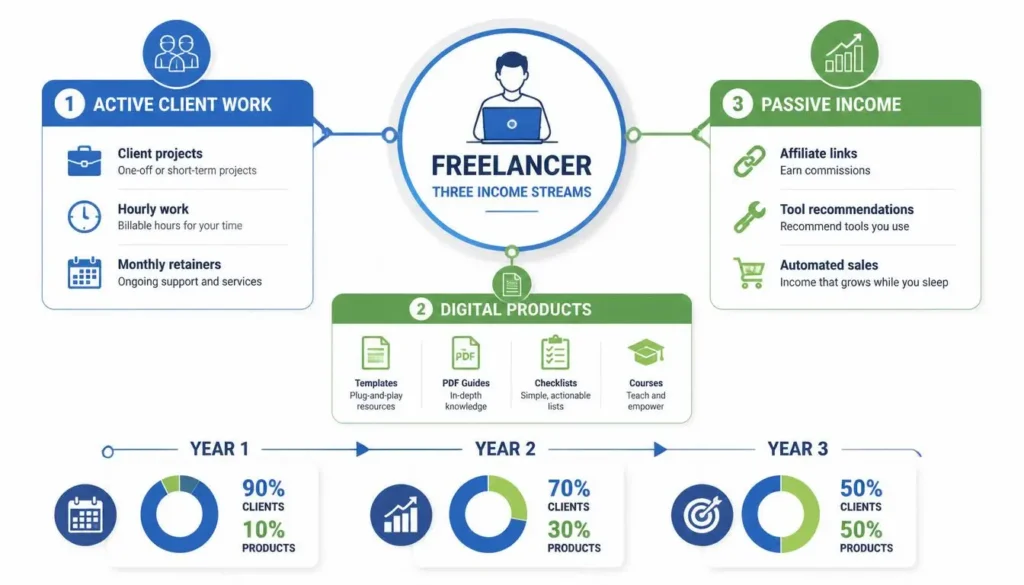
There are three types of income streams available to a freelancer:
1. Active Client Work: This is your foundation income. You offer a direct service to clients, whether that’s content writing, graphic design, coding, website development, or anything else. You get paid for the work you do.
2. Digital Products: You create something once and sell it to multiple buyers, old clients and new ones alike. Examples include templates, guides, worksheets, and courses.
3. Passive Income: This comes from tool recommendations, affiliate partnerships, or automated systems that generate income in the background.
Realistic Income Distribution Over Time
This shift doesn’t happen overnight. Here’s how to think about it year by year:
- Year 1: 90% client work, 10% digital products
- Year 2: 70% client work, 30% digital products
- Year 3: 50% client work, 50% digital products
The benefit of building toward this balance is stability. Even in a month where you are too occupied with a full-time job to focus on freelancing, your products keep selling and income keeps coming in.
Step 1: Convert Your Skill Into a Product
The first step is identifying what work you are doing repeatedly for clients. That repetitive work is your product.
Here are some examples based on niche:
Content Writer: Blog templates, content calendars, SEO checklists, headline formulas
Graphic Designer: Social media template packs, Canva templates, brand kits
Website Developer: Website templates, code snippets, documentation guides
Resume Writer or Career Coach: Resume templates, LinkedIn optimization guides, interview preparation checklists
Look for the pattern. Whatever you are doing repeatedly for clients, you can package it into a product and sell it to many buyers instead of doing it manually every time.
Step 2: Create Your First Digital Product
Most people think they need to create a full course with multiple recorded videos to get started. That’s not true. You can start simple.
Level 1: The Easiest Starting Point
Create documents, PDF guides, checklists, or templates.
- A PDF guide can be made on Canva in 2 to 3 hours
- A checklist can be built easily on Google Docs
- Templates can be made on Notion or Google Sheets
Price it affordably in the beginning (Rs.500 to Rs.1,000 range for your first product).
Level 2: Toolkits and Bundles
Bundle multiple templates together with guides and worksheets into one package.
Total time investment: 15 to 20 hours. Selling price: Rs.3,000 to Rs.7,000.
Level 3: Courses or Workshops
These involve recorded sessions or live classes built around a structured curriculum in your area of expertise.
Total time investment: 25 to 40 hours. Selling price: Rs.15,000 to Rs.35,000.
Always start with Level 1. Build up as you gather reviews and testimonials.
Quality Checklist for Your Product
- Solve one specific problem, don’t try to cover everything
- Make it actionable, not just theoretical
- Use real examples
- Keep the design and layout professional
- Price it affordably in the beginning
- Increase pricing only after you have strong reviews and testimonials
A good PDF guide made in 5 to 6 hours (even over a weekend) is a great starting point.
Step 3: Set Up Your Distribution System
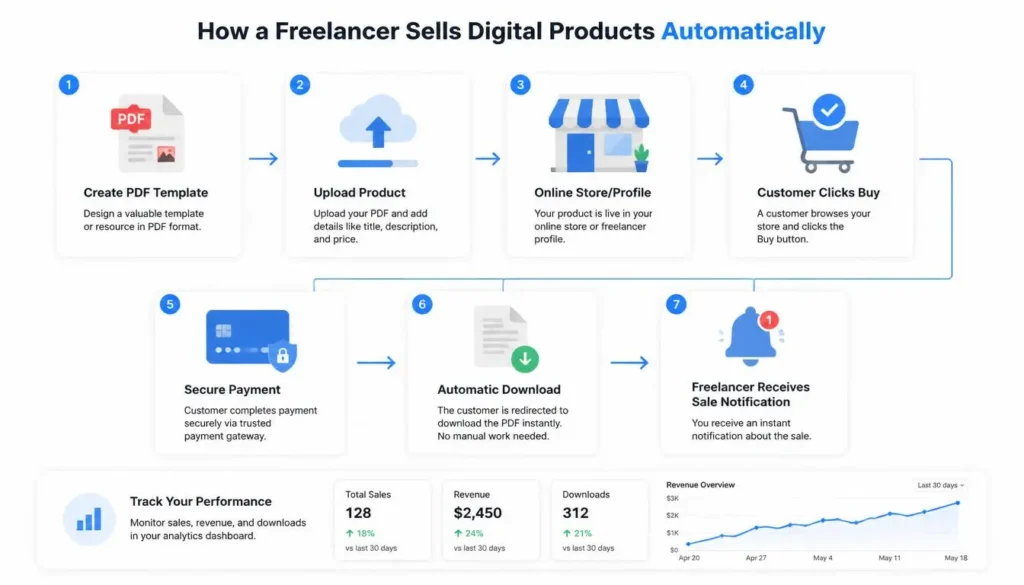
This is the most important step, and where most freelancers get stuck. They create great products but have no proper system to sell them.
The Old Manual Way (Don’t Do This)
Many freelancers used to:
- Add “DM for details” in their Instagram bio
- Share payment links manually via EasyPaisa, JazzCash, or SadaPay
- Send the product via a Google Drive link after payment
- Track everything in an Excel sheet
- Follow up with buyers over WhatsApp
This works for 5 to 10 sales. But when you want to scale, you need a proper automated system.
The Smart Way: One Centralized Setup
You need a single place where:
- All your products are listed
- Payments are automated
- Delivery happens automatically after purchase
- You can track everything from a dashboard
Platforms that work well for this include Gumroad, Payhip, and Lemon Squeezy — all of which support international sellers including Pakistan. Here is the general setup process that works across most of these platforms:
- Step 1: Create your account. Most platforms offer a free tier to get started.
- Step 2: Build your seller profile. Add a clear bio describing your expertise. For example: ‘Freelance Content Writer helping brands with storytelling.’
- Step 3: Upload your product. Add your PDF or file, write a clear product title, add a description covering what is included, who it is for, and what problem it solves. Set your price and add a cover image.
- Step 4 (Optional): Add services. For example, offer a one-hour consultation call and connect your calendar for availability.
- Step 5: Set up payments. Most platforms support international card payments and PayPal.
- Step 6: Get your public link. This is the link you promote everywhere.
Where to Promote This Link
- Instagram bio
- YouTube channel description
- LinkedIn profile
- Twitter profile
- Any other social media platform
- Email signature (especially if you have a professional domain email)
Setting this up takes less than 10 minutes.
What the Customer Journey Looks Like
- Customer sees your link on Instagram or any platform
- Clicks the link and sees all products and services on one page
- Clicks “Buy Now”
- Completes payment via card or PayPal
- Automatically receives the download link
Zero manual effort from your end. No screenshots to verify, no links to send, no follow-ups needed. You also get real-time notifications of every sale and access to a dashboard showing total revenue, top-selling products, and customer data for future targeting.
Step 4: Leverage Your Existing Audience
If you are already freelancing, you already have potential buyers around you. Here’s where to look:
- Past clients: Go through your list and identify happy customers
- Instagram followers or any social media following: These are already warm audiences
- LinkedIn connections: Very likely to be in your target market
- Email list: Even a small email list of potential customers is powerful
- Portfolio website visitors: People visiting your portfolio are already interested in what you do
Map out all these people. They are your first buyers.
Step 5: Combine Client Work and Products to Build a Self-Sustaining Ecosystem
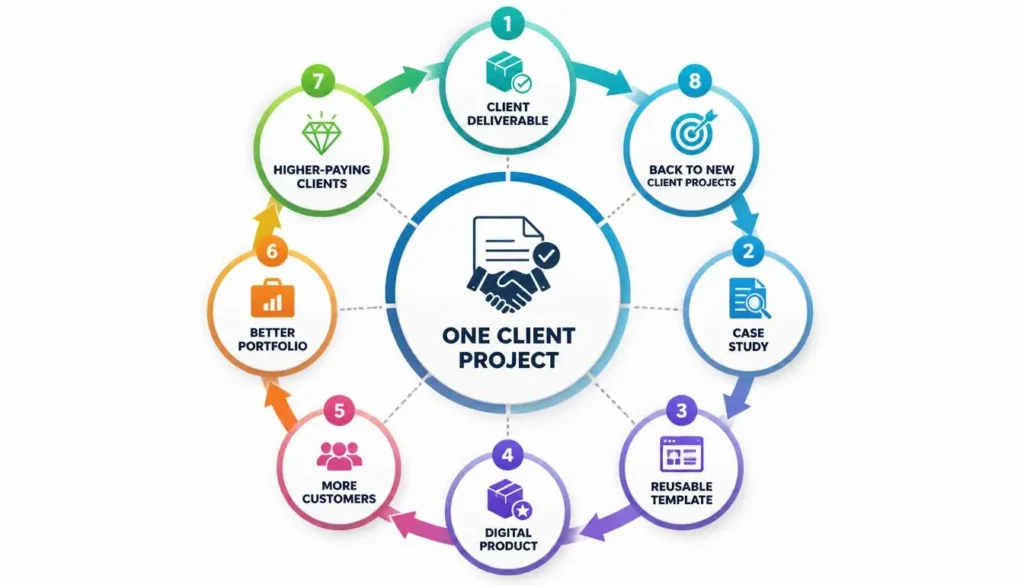
This is one of the most powerful strategies available to a freelancer.
Every time you work with a client, do these things:
- Document the process
- Save the templates you create
- Note down the common questions they ask
- Collect testimonials
One client project can give you multiple assets:
- The paid deliverable – your client work
- A case study – your portfolio material
- A reusable template – your next digital product
This creates a loop: better products bring more buyers, more buyers mean a stronger portfolio, stronger portfolio attracts better clients, better clients give you better material to document, and the cycle continues. Your system becomes self-sustaining over time.
Realistic Expectations: What to Actually Expect
When you’re just starting out, the temptation is to expect 2x or 3x returns quickly. That’s not how it works.
In the first month, even after putting in real effort, you might make just 10 or 15 sales. That’s completely normal, and it happens to most people when they’re just starting out.
Month 1-2: Build the product. Make initial sales. Don’t expect big numbers.
Month 3-4: Collect feedback from buyers. Improve the product based on what they say. This is what makes sales steady.
Month 5-6: Expand to multiple products. Track organic traffic. Watch for repeat customers. At this point, you begin to see consistent income forming.
Freelancing success never happens overnight. It takes consistent effort and smart work. If you are making an extra Rs.30,000 to Rs.45,000 per month from products in the beginning, that is genuinely something to be happy about. The goal then is to figure out how to scale that smartly.
Common Mistakes Freelancers Make (And How to Avoid Them)
Mistake 1: Creating too many products at once. In excitement, many people build 10 to 12 products immediately and then struggle to sell them. Start with one or two, test the results, and then move forward.
Mistake 2: Pricing too high from the start. Even if your product is good quality, keep the price affordable in the beginning. Once it starts selling well and you have reviews, then raise the price.
Mistake 3: Not promoting your products. Your product will not sell itself. You have to actively promote it. Talk about it openly on every platform you use.
Mistake 4: Giving up too early. If success doesn’t come in the first one or two months, people quit. Don’t do that. Keep going, take feedback, and improve. That is what separates those who succeed from those who don’t.
Mistake 5: Overcomplicating everything. Keep the setup simple. You don’t need a complicated system to start. Simple and consistent beats complex and inconsistent every time.
The Mindset Shift That Makes All the Difference
The mindset shift described below is what separates freelancers who scale from those who stay stuck.
If you have had a salaried job, your mindset as an employee is very different from what you need as a freelancer. Salaried employees tend to think in traditional terms, do the work, get paid. Freelancers need to think like entrepreneurs.
Here is a simple example. If you are a writer:
Employee mindset: I will get a writing job and earn from that.
Freelancer/entrepreneur mindset: I am a writing business expert. I can do active client projects. I can create writing templates and sell them as products. I can build writing courses. I can recommend tools to other writers and earn affiliate income.
That is the same skill, writing, but with multiple income streams attached to it. This is where real freedom comes from. When your income is not fully tied to the hours you work, you have time freedom, location freedom, and the ability to scale.
Disclaimer: This article is for educational and informational purposes only. Income results from digital products vary greatly depending on your niche, effort, audience, and product quality. The tools and platforms mentioned in this article are referenced for informational purposes only. Do your own research before choosing any platform for selling your products.